Showing posts with label Food. Show all posts

Monday, October 12, 2009

Eat Your Oats

I'm always looking for a way to jazz up my oatmeal. I've been eating oatmeal since I was, well, born. Although once in awhile I do enjoy a nice bowl of plainly seasoned oatmeal, plain can get old pretty quickly. Luckily, there are plenty of easy ways to spice up those heart-healthy oats.

I went home this weekend and got a chance to pick some apples at the orchard up the road from me. After waking up the next morning, I decided the apples would be the perfect compliment to my oatmeal.
This simple and delicious breakfast is similar to apple pie, except a whole lot quicker and healthier.

Fried Apples

-5 medium apples (Whatever variety is in season or looks best), peeled and thinly sliced
-1 Tbs. oil
-1 tsp. cinnamon
-Honey, to taste
-Salt, to taste

Heat the oil in a large skillet pan. Add the apples and cinnamon and cook until soft, approx. 15 minutes. Sprinkle with salt and drizzle with honey. The amount of honey will vary depending upon the variety of apples used. Sour, cooking apples such as Granny Smith may require more honey than a sweeter variety such as Jonagold.

Serve alongside oatmeal and enjoy!

Friday, October 9, 2009

Bake Sales Banned?

The classic school fundraiser, the bake sale, will no longer be an option for kids in NYC. The education department, with some exceptions, has banned bake sales in New York City schools. The new policy was actually put into place last year, but it is said that this is the first year where the rules and regulations will be strictly monitored.

It's no wonder the education department started second guessing school bake sales. They reported that roughly 40 percent of the city’s elementary and middle school students are overweight or obese. All those cookies and brownies can't be good for students' physiques.

According to the New York Times, the new policy also limits what can be sold in vending machines and school stores. However, after 6 p.m., allowance of bake sales is back on. So as long as your munching down your high-calorie snacks and putting on the pounds after school, the education department is okay with it.

While the education department has addressed unhealthy snacks during in-school hours, nowhere in the policy does it mention an altercation of the schools' cafeteria food. While there is finally a movement towards schools serving healthier food of better quality, there are still few who actually do so. When I went to school, they served us low-grade chicken nuggets, greasy beef tacos, slimy lunch meat, chicken patties, pan pizza, sugary chocolate milk, off brand tasty cakes, and other such unhealthy, fatty food choices. I could make at least a 5 page list of all the crap they served us. And while I got fed up with the unable-to-swallow food they served us, I was one of the few who actually took the time to pack a lunch. While my friends often complained about the food and would have welcomed healthier options, they didn't want to spend their time (or possibly their futile reputation) making a lunch. Reasons like this show why schools need to give students a little push and serve healthy, edible choices, not just the few parents or kids who take it upon themselves to eat healthy.

According to the Centers for Disease Control and Prevention, the percentage of overweight young people in the nation has more than tripled since 1980. That statistic right there tells you that healthy eating habits need to be not only taught, but enforced in schools. Bake sales can't just be banned. Real, healthy food needs to actually be served to students.

If healthy food were to be served in the cafeterias, then maybe an occasional in-school bake sale would be okay. Instead of being condemned for health purposes, bake sales could be looked at as a fun treat that kids can integrate into their already healthy lifestyles.

Young kids shouldn't have to be going on diets, watching their weight, or deprived of traditional bake sale fundraising opportunities. Young kids should just be able to run around and be kids. But that's just the problem. In today's society, many kids aren't running around, and many parents and schools are feeding their kids crap. This makes it so fun events, such as bake sales, have to be banned.

New York is not the first area to ban school bake sales, however they do have some of the strictest regulations. Other places, such as California, have banned bake sales or at lesat put a limit on the sugar and fat content of snacks.

However, I think schools need to stop focusing their time on school treat regulations and start putting their efforts towards changing the meal that almost every kid eats- school lunch.

Thursday, October 8, 2009

How to Get The Most Out of Your Veggies

If you're unaware that vegetables are filled with vitamins and nutrients, then you might as well not be a human being. However, what you might not know is that the way you cook vegetables can greatly determine how much of those vitamins and nutrients you're actually taking in.

A study done in the UK showed that that boiling vegetables, particularly ones in the cruciferous family (such as broccoli, brussel sprouts, cabbage, cauliflower, kale), significantly reduces their cancer-fighting properties. Gucosinolate, which converts to isothiocynate, a cancer fighting chemical which helps to remove cancer causing constituents within the body, is almost entirely destroyed when vegetables are boiled.

Also when boiled, many of the vitamins and nutrients are lost in the water that covers the vegetables. If you must boil your veggies, save what will become nutrient-rich water for a soup or gravy.

One of the best alternatives to boiling veggies is steaming them. While the cooking process is similar- bring the water to a boil and then place the vegetables in the pan- steaming requires a steaming basket which keeps the vegetables from being saturated in the water. By filling up the pan with water so that it just reaches the bottom of the steamer basket, not as many of the vegetables' nutrients can be lost to the water. Generally vegetables lose 50% less minerals during steaming than boiling.

A study published in the Journal of Food and Science, showed that one of the best ways to retain nutrients is through microwaving the vegetables. They tested six different cooking methods using 20 different kinds of vegetables, and concluded that microwaving maintained the highest level of antioxidants. Although, I am weary of the use of microwaves as I fear we aren't quite sure exactly what the repercussions may be that come from using them. Considering people seem to be microwaving everything these days from sweet potatoes to rice to raw meat, I have made a personal choice to limit my use of the microwave. It is said that when food is microwaved, the molecular structure of that food is modified. I am simply weary of facts like that. However, if in a squeeze, it looks like it might prove to be beneficial when it comes to cooking vegetables. Though, when it comes to cauliflower, skip the microwave. The above study found that the highest loss of antioxidants came from microwaving cauliflower.

Other methods of cooking vegetables include baking and frying. While these methods are okay for some vegetables and can certainly make tasty dishes, the higher the heat used, the more nutrients you'll tend to lose. For example, frying potatoes at a high heat in order to make french fries causes them to lose up to 90% of their vitamin C.

Another way to eat vegetables, which seems to be a huge trend especially on the west coast, is to simply not cook them at all. Steaming a vegetable for just 30 seconds will alter the amount of nutrients it contains. Eating vegetables raw assures that you don't lose any nutrients from the cooking process. However, in some cases, cooking vegetables can actually enhance nutrients. For instance, healthful sulfur-containing compounds within onions and garlic are actually released through the cooking process.

Also, make sure that you're getting your vegetables fresh. Time can greatly decrease their nutrient contents, which means the longer you wait to eat the veggies, the less nutrients they'll contain. Use this tip to get you to eat more vegetables. If you have veggies in your fridge, eat/cook them!

The bottom line: it's important to eat your vegetables no matter how they're cooked. Opt for steaming, or if in a pinch for conveniance, microwaving, and try to stay away from overcooking. Make sure they still retain some of their natural vibrant colors after they're done cooking. And if you really want to ensure you're getting the optimal nutrients from your veggies, cook up some artichokes. Artichoke were the only vegetable in the Journal of Food and Science study that kept its high antioxidant level during all of the cooking methods.

Monday, October 5, 2009

Prudently Pick Your Potato


When it comes to potatoes, not every one is created equal. Sweet potatoes by far outshine regular potatoes when it comes to your health. In fact, according to the Center for Science in the Public Interest (CSPI), those orange, candy-like potatoes rank #1 among all other vegetables.

One of the main differences between sweet and regular potatoes is that sweet potatoes have a low glycemic index rating. This means that they are digested slowly, allowing blood sugar to rise at a gradual rate. This makes the consumer feel fuller for a longer period of time. Potatoes on the other hand have a high glycemic rating, causing the blood sugar to spike upon eating them. High glycemic foods can be taxing on the body, whereas low glycemic foods help maintain steady energy levels. Low glycemic index foods promote weight loss, a decreased sensitivity to insulin, a decrased risk of heart disease, and lower cholestorol levels.

Sweet potatoes are about twice as high in dietary fiber as a typical Russet white potato. So although they seem very sweet and sugary, the fiber slows the release of the sugar preventing any harmful spike in blood sugar.

Both types of potatoes contain substantial amounts of nutrients. However, sweet potatoes are more concentrated with antioxidants, such as vitamin A containing twice the daily recommendation of the vitamin. They also have plenty of vitamin C, manganese, iron, vitamin B6, and potassium. Both the vitamin A & C within sweet potatoes help to get rid of cancerous free radical molecules which damage cells and cell membranes.

Another distinct difference is regular potatoes are part of the nightshade family. Vegetables that fall under the nightshade family, which include green peppers, eggplant, and tomatoes, are often associated with triggering arthritis flare-ups. Nightshades also contain alkaloids of which can trigger allergy-like symptoms. For those with arthritis, many nutrtionist recommend staying away from nightshade vegetables all together, making sweet potatoes a better choice.

Regular potatoes are also often prepared in ways that contain a lot of fat and calories, such as greasy french fries, buttery mashed potatoes, mayonnaise-y potato salad, and addictive potato chips. While all of these are certainly tasty, they pretty much all contain a lot of fat and salt, making it an addictive combination which can often lead to overeating. If you are going to eat regular potatoes, make it simple by steaming them and adding a little olive oil, S&P.

Sweet potatoes are extremely easy to prepare considering they just taste naturally delicious. Simply wrap a sweet potato in aluminum foil, and bake at 375 degrees for 45-60 minutes. Once the potato is soft enough to mash, remove from the oven. Add a little salt and maybe a dab of butter or drizzle of olive oil and enjoy. I can eat sweet potatoes like this for breakfast, lunch, and dinner. And make extra because they're even good left over without even having to heat them up. However, to reheat them, simply nuke them in the microwave for a minute or so.

You can also chop sweet potatoes into cubes, place them on an aluminum lined baking sheet, and top them with a little cinammon and maple syrup and let them caramelize in the oven.

Or to make savory sweet potato fries, check out this recipe from Women's Health magazine:
Spicy Sweet Potato Sticks
Peel 1 sweet potato and cut lengthwise into 3 or 4 pieces, then cut each piece lengthwise into finger-size slices. Add 1 tablespoon olive oil to a bowl and toss with potato to coat. Add a pinch of salt and pepper and 1 tablespoon chili powder blend, paprika, or chipotle steak seasoning. Toss again to coat. Spread potato sticks evenly on a baking sheet and roast at 400 degrees F for 30 minutes, turning them once halfway through. Makes 1 serving.

Sunday, October 4, 2009

Beware: Poo On Your Meat

Since I am a pescetarian (a vegetarian who abstains from eating all meat with the exclusion of seafood), I luckily don't have to worry about what's going into my hamburgers. My "hamburgers" usually consist of beans or soy products that aren't as likely to be contaminated with harmful bacteria such as E. Coli. (Interested in trying a good meatless burger? Try Flame-Grilled Boca Burgers. Boca's breakfast 'sausage' links are also really tasty.)

However, for those of you who do occasionally indulge in a hamburger, you may want to beware of what you're ingesting. While I certainly don't condone those who eat meat, nonvegetarians definitely need to be more careful when it comes to handling and purchasing foods. The New York Times, recently published an article that exposed the meat industry in their process of making hamburger meat. What the article had to say wasn't all that pretty...

The article was a little lengthy, so I'm going to highlight some of the important and of interest points, much of which could be of concern to any meat-eater.

The NY Times constructed the article around Stephanie Smith, a woman who ingested a burger containing E. Coli and as a result is now paralyzed from the waist down. Doctors also say that her kidneys are at a high risk of failing. The human body contains two kidneys that work to remove waste from the blood of which is then transported out of the body when we urinate. Kidney failur can cause longer term disability or even death. One kidney must remain functional in order to survive. Doctors say that most likely Ms. Smith won't ever be able to walk again.

According to the NY Times, most patients are able to recover from E. Coli toxification. However, in the worst cases such as Smith's, the bacteria can penetrate the colon wall, damaging blood vessels and causing clots which can lead to seizures. The seizures can be so intense that they can inhibit the brain from properly function for periods of a time. Even in less severe cases, patients are almost always sure to become sick. According to WebMD, ingestion of E. Coli O157:H7, the strain that causes food-borne illnesses, will cause symptoms such as severe stomach cramps, nausea, vomitting, and diahrrea. If the illness doesn't reach a severe stage, symptoms will generally last for about a week or so.

So how is E. Coli getting into market-sold products? The NY Times did a large examination of the meat industry to try and answer this question. They found that hamburger meat sold at the supermarket is almost always a blend of different grades of meat from various parts of the cow, coming from numerous slaughterhouses. Food experts say that the cuts of meat used are particularly vulnerable to E. Coli contamination. Cargrill, the company that processed the meat of which contaminated Ms. Smith, used a large blend of meats which allowed them to spend 25% less than if they used cuts of whole meats. While they may have initially saved some money, this ensued several multi-million dollar claims by some of the people who got sick.

The ingredients Cargrill used came from slaughterhouses ranging from places like Nebraska, Texas, South Dakaota, and all the down to to Urugway. The largest and cheapest component used in making ground hamburger meat is beef trimmings, which contain 50% fat, 50% meat. The article stated that in large grocery store chains such as Publix Super Markets, in order for customers who want to make a hamburger from meat obtained from whole-cuts, they'd have to purchase a steak and have it specially ground, said a Publix spokesperson.

The low-grade meat trimmings are cut from areas of the cow that are more likely to be contaminated by feces (Poo). The cattle in slaughterhouses are often smeared with traces of feces that harbor E. Coli. In order to keep the feces from contaminating the meat, the cattles' hides, which are particularly close to the outer trimmings obtained from the outer surfaces of the carcasses, must be very carefully removed. This can easily be slipped up, as the large clamps holding the hide often slip and smear feces onto the meat. Also, it's easy for workers to unintentionally spread feces to the meat they are handling as they quickly and often unmindfully slice away the hides. Inspectors have said that E. Coli are also particularly present at the intestines gutting stations within slaugtherhouses.

And while slaughterhouses and meat processing plants can't quite be compared to the conditions of extreme squalor described in Upton Sinclair's The Jungle, the environment is by far still not adequately clean and pristine. Inspectors at Cargrill found large amounts of meat patties thrown on the floor, old bits of meat hanging of meat grinders, and workers dumping indedible meat on the floors beneath production lines. None of this speaks of healthy sanitation to me.

The NY Times reported a survey taken by the Agriculture Department of more than 2,000 plants that taken after the Cargill outbreak. The survey showed that half of the grinders did not test their finished ground beef for E. coli, and a measly 6 percent said they tested incoming ingredients at a very measly least amount of four times a year.

While there is no federal requirement for grinders to test their ingredients for E. Coli, a lot of companies do set their own standards and testing. However, many companies such as Cargrill, don't even follow their own safety programs, the same ones they made. The reason that federal requirements haven't been made is because industry officials claim that the cost of testing could unfairly burden small processors and that slaughterhouses where the meat is purchased already test for the pathogen. However, meat is a delicate food when it comes to bacteria growth. You would think that it would be more important for thorough standards to be set so that vicitims such as Ms. Smith wouldn't have to worry about what they're buying or eating from the grocery store.

A direct quote taken from the NY Times article stated this: "Dr. Kenneth Petersen, an assistant administrator with the department’s Food Safety and Inspection Service, said that the department could mandate testing, but that it needed to consider the impact on companies as well as consumers. “I have to look at the entire industry, not just what is best for public health,” Dr. Petersen said."

Isn't public health more important than the industry's financial gain? Without health, money means nothing. And clearly, being sued for multi-millions isn't doing much for companies in terms of finance.

To make matters worse, many slaugtherhouses won't sell to grinders who test their meat. Slaughterhouses fear that one grinder’s discovery of E. coli will set off a recall of ingredients they sold to others. So basically, they don't care if they are selling contaminated meat and harming customers as long as they can continue selling their products. Taken from the Times article: The food safety officer at American Foodservice, which grinds 365 million pounds of hamburger a year, said it stopped testing trimmings a decade ago because of resistance from slaughterhouses. “They would not sell to us,” said Timothy P. Biela, the officer.

These cases don't help to cast capitalism in a good light. Workers at Greater Omaha, another meat processing company, filed a suit against the company saying that they weren't getting paid for the time they spent cleaning contaminants off their knives and other gear. Greater Omaha is contesting the suit...but if this is true, most likely workers aren't paying attention to the details of cleaning their utensils, meaning bacteria is probably left to reside on them.

The Times found that even the safe handling instructions of meat can not enough fully prevent the bacteria of meat from spreading in the kitchen. The E. Coli pathogen is so powerful that it can cause illness from just a few cells left on a counter. “In a warm kitchen, E. coli cells will double every 45 minutes,” said Dr. Mansour Samadpour, a microbiologist who runs IEH Laboratories in Seattle, one of the meat industry’s largest testing firms.

While companies treat their fatty trimmings with ammonia, yes, ammonia, it is often still not enough to prevent E. Coli contamination. The bottom line is this: Be weary when buying any meat, especially meat that is highly processed. It's generally best to get meat from a local butcher of whom you can get to know. Also, free-ranged, organic meat is generally safer and prevents less animal cruelty living conditions. While it may cost you a few extra bucks, the money is worth your health and your conscious.

Here's my only vegetarian pitch...If you're going to eat meat, maybe try consuming a little less of it. Especially if you have you're own garden, you don't have to worry quite as much when you're cooking up simple, unprocessed veggies and beans. Stick to the basics and your mind and health is generally worry-free.

To read the whole NY Times article, go to: http://www.nytimes.com/2009/10/04/health/04meat.html?pagewanted=1&_r=1&th&emc=th

Friday, October 2, 2009

Healthy Snacking

Snacking can be healthy when done in the right away. That means, staying away from high fat, empty calorie snacks, and opting for something with a little bit more fiber and/or protein. Sometimes snacks are the perfect pick-me-ups and can keep you from overindulging later in the day. Check out the following healthy picks that will be sure to leave both your brain and tummy satisfied.


Salty
-
1/4 cup of dried, unshelled edemame- These come in a variety of flavors. If you're looking for something simple, try the sea salt. If you want a little kick try my favorite, wasabi. One serving has a mere 140 calories and a whopping 14 grams of protein.
-1/4 cup of hummus with a few baby carrot sticks- I am absolutely in love with hummus. In high school, I ate hummus sandwiches like other people at PB&J, nonstop. This creamy, mediterranean dip is primarily made out of protein-packed chickpeas and heart-healthy fat containing sesame tahini. This snack is guaranteed to leave you completely satisfied, with only an added 80 calories to your days consumption.

Sweet
-
One 8oz container of Fage 0% Greek yogurt with one tablespoon of honey- Greek yogurt is particularly dense and creamy, even without the fat. Add a tablespoon of honey and the snack comes to 180 calories (energy) along with a full 20 grams of protein. Mmm.
-Two individually wrapped Dove Dark Chocolate squares- Costing just 84 calories, the individually wrapped squares assure that you won't down a whole candy bar. Plus, a little dark chocolate can actually be good for you. And, when it comes to dark chocolate, a little goes a long way in making your tastebuds satisfied.
-An apple or banana- You can't go wrong with a piece of fruit. Typically containing around 80 calories, nature's sweet candy is filled with fiber and nutrients. Heck, if you're really hungry, indulge yourself in two pieces.

Savory
-
One tomato, sliced and sprinkled with 1 oz. feta cheese- This 100 calorie snack is the perfect combination between juicy, salty, and savory. Add some basil for a little extra punch of flavor.
-Zesty BBQ Soy Crisps- Crispy and savory like BBQ potato chips, without all the greasy fat. Try a brand such as Genisoy which enhances their crisps with soy protein. One serving packs just 120 calories and 7 grams of protein.

So the next time you reach for a snack, skip the Doritos and the gummy bears and try out these options, which are more nutritious but equally as satisfying. Determine if you're craving something salty, sweet, or savory and give it a go. There are tons of snacks that aren't on this list that are just as healthy and delicious. When it comes to snacking, aim for something under 200 calories with at least 2 grams of fiber or 6 grams of protein per serving.

Sunday, September 27, 2009

What Not To Drink

Since my latest posts have been revolved around the the subject of drinking fluids and how much of them to drink, I thought I'd continue the theme by giving the low-down on what beverages one should absolutely refrain from consuming. Drinks can really add a punch to your pouch. Often loaded with empty calories, beverages can easily cause you to put on some extra weight without you even knowing it. While drinks may be packed with calories, people don't often associate the calories in drinks as they would with food. Consuming a 155 calorie granola bar would probably leave a person feeling satisfied or at least curb their hunger, whereas a person downing that same amount of calories by drinking a can of Coke often wouldn't feel full, especially mentally. Therefore, the calories in drinks often aren't compensated for later in the day and end up being purely extra calories added into the diet.

While countless drinks are unhealthy, containing loads of sugar, artificial sweeteners, and food-colorings, there are a few that particularly stand out as being atrocious in terms of one's diet. Try to avoid consuming the following drinks, as they are loaded with calories and aren't beneficial at all to one's health.

-Venti Double Chocolate Chip Blended Creme Frappuccinno: This drink has more calories and fat than in a typical meal, containing 670 calories and 22 grams of fat. That's as much fat and more calories as two McDonald's cheeseburgers. In fact, I would tend to stay away from Starbucks in general, considering more than a handfull of drinks on the menu contain as much calories and fat as most meals on fast food menu. For instance, the hot chocolate with whip creme has a whopping total of 24 grams of fat. Is this something you really want to be guzzling down? Wake up with something a little more healthful, such as a homemade green smoothie. If you really feel the need to hit Starbucks on your way to work, opt for a cappuccino with soy or nonfat milk (about 80 calories), or simply stick to a plain cup of joe.

-Margarita- Going out for a night on the town? Well, skip this drink. With their often exotic sounding flavors and bright, neon colors, Margaritas can often sound like the drink of choice. However, they'll cost you about 400 calories, a ton of sugar, and lots of processed food colorings. And while they may look appetizing, unless you're getting them fresh such as in the Caribbean islands, they usually taste like syrupy, processed crap. Stick to something lighter such as a Mint Mojito (180 calories), a simple combination of rum or vodka, a little sugar, fresh squeezed lime and fresh mint. This drink refreshing drink is sure to leave you satisfied and walking out of the bar a little lighter than that loudmouth sipping on a candy apple margarita.

-"Juice Drinks"- Juice can be deceiving. I often find myself quickly grabbing something such as a bottle of cranberry juice at the gas station, only to find out once I get to my car that what I grabbed is not really juice at all. In fine print, labels often read "10%" juice...then list off a bunch of artificial flavorings and processed ingredients. I didn't want 90% crap, I wanted juice god damn it! Juice as it is isn't as nutritious as eating the actual fruit, but it's even worse when if the "juice" you're drinking barely even contains the fruit from which its titled. When choosing juice, make sure the bottle says 100% juice, and limit yourself to one serving size. Since juice is very concentrated, it tends to be high in calories and sugar, and unlike the fruit, it contains no fiber so it often won't make you feel full like eating an actual apple would. One small juice box often contains 100 calories which is more than if you just ate the actual fruit. If you're craving something sweet, go for the real fruit and grab a glass of water to clench your thirst, rather than downing 100 calories in a few quick sips from a juicebox.

These are just a sample of the high calorie drinks that are out there. In general, use sodas, juices, and coffee "milkshakes" as treats, rather than daily consumptions. Stick to water which is actually the best at doing its job of clenching one's thirst. If you're looking for a little variation away from your everyday water, check out these natural, low-cal, refreshing beverages.

Tuesday, September 22, 2009

Monday, September 21, 2009

Life is Like a Box of Chocolate


If there's one food that I can say I truly love other than peanut butter, it's got to be chocolate. The combination of my two favorite foods isn't bad either. Lucky for me, recent studies have shown that chocolate may actually be healthy, as long as it's eaten in small amounts. However, this still proves to be a contentious issue among health experts. Many defy claims about the health benefits of chocolate, and say that even if true, chocolate's unhealthy properties outweigh any positive benefits. I did some research to find out the real deal about chocolate: Healthy or not?

-Chocolate-eaters have increased survival rate after heart-attacks: A study done in Sweden followed 1,619 first-time heart attack patients for 8 years succeeding their first heart attack. Scientists tracked the patients' chocolate consumption and concluded that those who ate more chocolate were more likely to survive. However, while the study did account for such factors as age, obesity, sex, physical activity, and education, it didn't account for factors such as mental health.
*Chocolate contains flavanols, antioxidants of which are supposed to have a positive effect on the cardiovascular system. The flavanoids are supposed to help increase the elasticity of blood vessels as well as help prevent blood clots. This information helps to prove the study may have some actual signifigance.
*Similarly, other studies have shown that chocolate decreases blood pressure.

-You gotta go dark- While chocolate does contain heart-healthy antioxidants, similar to those in various fruits and vegetables, tea, and red wine, not all chocolate is created equally. According to the Mayo Clinic, the darker the chocolate, the more substantial the amounts of flavanoids. While those sweet milk and white chocolates may seem good to your taste buds, they're pretty much worthless in terms of boosting chocolate's healthy reputation. Fortunately, I prefer dark chocolate over other varieties anyways. If you're not a fan of dark chocolate though, I at one time could relate. At first, I only really liked milk chocolate. However, my entire family preferred dark chocolate, so that would essentially be the only treat lying around our house. After continuously sampling the dark, it eventually grew on me to the point that I don't even really like the taste of milk chocolate that much anymore (that is, unless it's paired with my fav. PB, such as in Reese's...mm). If you like dark chocolate in the least bit, making the switch won't be that difficult.

-Beware, even dark has its problems: While dark chocolate does have a significantly higher amount of flavanoids, you still can't just choose any dark chocolate. Processing methods can often notably decrease the flavanoid content in chocolate bars. To ensure that you are actually reaping the health benefits of eating dark chocolate, choose bars that have few added ingredients and limit damaging processing procedures. Try CocoaVia products, which use a method of processing that helps to limit the damaging of flavanoids. Also, choose bars that contain at least 70% cocoa. I especially enjoy Lindt chocolate, which offers a wide variety of dark options. Scharffen Berger chocolate is also a tasty option.

-Skip the milk- While you may absolutely have to have that glass of milk when munching on cookies, skip it when it comes to eating chocolate. A protein in milk binds to the flavanoids in chocolate, making them less easily absorbable. Having a dark chocolate cookie (although this may not apply anyways because of the processing, but just in case)? Pour yourself a nice glass of soy milk, and feel free to go for the dunk.

-Don't forget to limit yourself!- While all these tips and potential health benefits do sound absolutely wonderful to any chocoholic, chocolate should still be eaten in moderation. Although dark chocolate contains the same antioxidants as various fruits and vegetables, it is significantly higher in fat and calories! You're common sense and conscious should tell you that a chocolate bar a day will not keep the doctor away. The typical chocolate bar is almost 50% fat, with a signficant amount of it being saturated. You only need a small amount of dark chocolate to benefit. Instead of gourging yourself on a daily basis, save it for special occasions, or use it to replace other artificial/processed/unhealthy sweets.

Saturday, September 19, 2009

How to Wake Up Without Needing “Joe” By Your Side

Are you one of the many who finds yourself dependent on coffee in order to wake yourself up in the morning, especially if you plan on sporting a smile on your face? Does your whole day seem off if your coffee machine isn’t started first thing or if you don’t swing by Starbucks on the way to work to get your daily dose of caffeine? Well, you’re not alone. According to the National Coffee Association of the U.S.A., 54% of Americans drink coffee beverages daily, meaning approximately 400 million cups of coffee are consumed everyday in the U.S.

However, just because coffee is significantly popular doesn’t mean daily consumption of it is healthy, and it certainly isn’t very beneficial when it comes to keeping money in your pockets during these bleak economic times. Although coffee may provide some benefits if drank in moderation, it poses negative risks to your health when excessively consumed. Caffeine, one of coffee’s most loved properties, can contribute to anxiety, irritability, restlessness, and an interference with one’s natural sleep schedule. “The effects of caffeine can sometimes backfire, for instance if you are trying to study or really concentrate on something,” says Nicole Patience M.S., R.D., C.D.E, registered dietician at Temple University.
Because of the caffeine it contains, coffee also dehydrates the body, in the long run taking away from its rejuvenating effects. Since coffee masks the feelings of fatigue, it will often induce the body to crash later on in the day, causing an unnatural cycle of continuous crashing and artificially refueling using caffeine.
Also, due to its caffeine, coffee is addicting (which is most likely why you find yourself drinking it every morning). When consistently consumed, a withdrawal from the substance may cause symptoms such as headaches, fatigue, depression, nausea, and lack of concentration. Coffee is similar to a drug in that it causes many people to become heavily dependent on it. No one wants to have to be dependent on something else to keep a sense of sanity. So why not keep your independence and save a few bucks by waking up in a more natural way? Utilizing a combination of the following five easy options will help you to wake up feeling refreshed, energized, and happy—the natural way.

1. IMITATE THE SUN FOR 10 MINUTES OF YOUR MORNING (IT NEVER SEEMS TO HAVE A PROBLEM WAKING UP)
As you wake up with the sun, mimic it by stretching your body as it stretches its rays towards the sky. Recycle the time you would spend making or driving to get coffee, and instead use it to start your morning off productively by engaging in ten minutes of gentle stretching alongside the sunrise (or sun’s rays if its already finished waking up). Stretching increases blood flow to your muscles and naturally awakens the body. It also helps to relieve tension in the body and fight off any stress that you may build throughout your day. “Stretching relieves chronic tension that actually wastes energy, coming from holding the muscles in tight,” said Mick Grady, a yoga teacher and therapist at the Himalayan Institute. “By relaxing the muscles [through stretching], you regain that energy rather than just wasting it to tension.” Try engaging in a few rounds of sun salutations, a sequence containing a combination of forward and backward bends consisting of about 12 poses. “Sun salutations have a lot of variation and are a great way to start moving and invigorating the body,” said Grady. Notice how with each stretch your body slowly starts to awaken and becomes revitalized after a long night’s rest.

2. GET YOUR GROOVE ON
Put on some Michael Jackson or any of your other favorite upbeat tunes and start your body’s endorphins by shaking that body of yours. Dancing will not only wake you up by increasing the circulation in your body, but it will more than likely put a smile on your face as well. According to the Mayo Clinic, just 10 to 15 minutes of aerobic activity, such as dancing, can boost your mood. No longer will you need that cup of coffee to happily awaken you.

3. EAT, EAT, EAT
Breakfast: Yes, this is the time where it’s absolutely vital to chow down on some food. Breakfast stimulates your metabolism, replenishes your blood sugar, and refuels your body to give you the energy necessary to start your day. “Breaking breakfast down into ‘break’-‘fast’, breakfast means you are breaking your fast from overnight,” says Patience. “Your body uses energy while sleeping and breakfast replaces this energy. By starting to eat meals early in the day, the body can start to burn energy instead of having to conserve energy to refuel later in the day.” However, it is important to eat a nutritious breakfast that contains limited amounts of refined sugar products, which spike your blood sugar and can send you crashing later in the day. Stick with nutrient loaded fruits, which contain just enough natural sugar to perk you up without hindering energy levels later on. Choose whole grains, which are rich in fiber and complex carbohydrates that will leave you full and keep you energized throughout the morning. Instead of taking the time to make a cup of coffee, energize yourself nutritiously by putting some oatmeal on the stove. Add in antioxidant-rich blueberries towards the end of cooking and top your oatmeal with a few chopped walnuts to give yourself a boost of protein. Drizzle a hint of maple syrup on top, and enjoy a healthy, naturally sweet treat that will make it almost impossible for you to miss your morning brew.
4. HAVE A CUP OF TEA
If you absolutely can’t ditch your morning caffeine, try sipping on a cup of tea, which typically contains much less caffeine than coffee. An eight-ounce serving of coffee has approximately 95 milligrams of caffeine, where as an eight-ounce serving of black tea (one of the highest caffeinated forms of tea) contains 47 milligrams, slightly less than half the amount in coffee. The subtle amount of caffeine in one cup of tea will help to awaken you without putting you as much at risk of addiction or of the negative side effects from overconsumption. “Small amounts of caffeine can be beneficial and help us be more alert during the day,” says Patience. Tea additionally provides many natural health benefits. Tea contains flavonoids and polyphenols that work as antioxidants and that help to lower the risk of certain diseases. According to WebMD, one study shows that tea has 10 times the amount of antioxidants than fruits and vegetables. Other studies have shown that green tea, which happens to contain between ½ to 1/3 of the amount of caffeine of black tea, reduces heart disease. According to the Mayo Clinic, a study in Japan showed that participants that drank green tea daily proved to have less memory difficulty than those who did not drink tea. So if you need something warm to replace your coffee, grab a cup of tea and simultaneously boost your antioxidant level, and maybe even your memory, while drinking.

5. CATCH UP ON YOUR ZZZ’S
There’s no natural way around it: your body needs sleep. In order to feel energized in the morning, getting enough of it is crucial. Without a good seven to nine hours of sleep (depending on your individual needs), you are never going to be able to feel your best, even with that cup of coffee. Sleep regenerates you and repairs any damaged cells from the day before. It is vital in order to maintain a peak level of alertness and concentration. Sleep also helps to monitor the many chemicals in your brain, such as serotonin of which high amounts are linked to depression. Therefore, sleep helps to keep you happy, the natural way, without the need of a caffeine boost. Try going to sleep an extra hour earlier and also try to stick with a consistent sleep schedule so that you will have no trouble falling asleep once you hit the pillow. The extra time spent sleeping will be worth it when you wake up feeling happy and fully refreshed, feeling no need to feed a persistent addiction. You will be able to increase your productivity as you start your morning fully concentrated and remain more awake throughout the day.

Wednesday, September 16, 2009

Fall Foodie Fun (another FFF)

Can you believe summer's over already? This coming Tuesday marks the first day of Fall! That means the coming of the end for peaches, tomatoes, green beans, and all those other summer good-eats. But don't get too disheartened because autumn gives way to a whole new batch of fresh fruits and veggies.

Start looking for these star items in your local farmer's market (or garden) the next time you're out:

- Fall greens (these include swiss chard, collards, and kale of which continue to thrive all the way into the early days of winter) - Best eaten simply steamed or sauteed with a little bit of olive oil, S&P, and garlic

-Butternut Squash- Mmm, these are sure to keep your tummy full and warm you up when those cool, breezy days start rolling your way- Best when baked in the oven with olive oil, S&P, and a sprinkle of cinnamon and a drizzle of honey if desired.

-Pears- These sweet treats are great for eating as is and make handy snacks. Try munching on some Asian pears which are currently at their prime. This variety of pear has a firm texture, but is as sweet and juicy as a watermelon.

-Apples- Nothing tastes better than an apple freshly picked off the tree. When apples are sold locally, it generally means they'll be riper = a sweeter, fresher taste. When the apples aren't being shipped halfway across the continent, growers are able to pick the appples closer to their peak ripeness, which means a better tasting apple for you.

-Sweet potatoes- This bright orange, vitamin A-filled vegetable is nature's candy. Naturally sweet and delicious, all these babies need is to be baked in the oven until soft and then seasoned with a little S&P. Add a dab of butter if you desire a little extra richness. Sweet potatoes also have quite the reputation. The Center for Science in the Public Interest has ranked sweet potatoes as #1 in nutrition among all vegetables. Dig in.

-Leeks- As a member of the onion family, leeks generally resemble onions, containing layered bulbs that are attached to long, leafy stalks. The taste can also be compared to that of onions, however leeks are much milder. They are great to use in soups, as well as in sautees. Use the light green stalks as well as the outer layers of the bulb, and simply sautee with a little olive oil and S&P.

So get out there and start sampling fall's wide array of fruits and vegetables. As winter rolls in, your chances to eat locally will quickly diminish, so don't be afraid to gourge yourself on produce in these next coming months. Eating locally is better for for both your body and the environment, so it's important to do so whenever possible. Harvard's Center for Health and the Global Environment states, "Food that is grown and harvested locally is usually given more time to ripen, increasing its nutrient value" (as well as its taste!). It also cuts down on the tons of greenhouse gas emissions generated by carting foods long distances.

Go to your farmer's market (or even better, your local garden) and get some produce. It's relatively simple to cook up. As a general rule of thumb, vegetables taste great either steamed until tender, or sauteed with some garlic. Either cooking method can be seasoned with some olive oil and S&P (as well as citrus or sweetness depending on the veggie). For fruits, savor them just as they are or try baking them and turning them into a dessert.

Happy Fall!

Thursday, August 13, 2009

Peaches...MMMmmm


It's peach season!! Lucky for me, I live only a few minutes away from a fruit orchard. That being said, I just got back from picking a basket full of softball-size peaches (and ate a basket full while doing so). Peaches are one of nature's many candies...they're so naturally sweet, and juicy, and delicious, and oh-so yummy...and paired with a bowl of vanilla ice-cream, they're extra "oh-so yummy" and sweet.

Take advantage of these summer treasures now because once they go out of season, you can rarely ever find peaches that get anywhere close to the taste of fresh ones. Like many fruits, peaches are super versatile. For a treat, pair them with ice cream, use them in a pie or tart, or cover them with brown sugar and cinnamon and put them on the grill. For a healthier treat, you can pair peaches with yogurt, cook them in oatmeal, or mix them with blueberries for the perfect fruit salad. My favorite is to just wash them, chop them up, put them in a bowl, and enjoy them plain...Mmmm.

Peaches are rich in cancer-fighting lutein and lycopene (the nutrients found in tomatoes). They are also a good source of potassium and are high in vitamins A & C. Peaches are full of fiber and full of water, making them a lo-cal food. While they do contain some sugar, it is all natural and this helps to give them their remarkable sweet taste.

Plan a time to go out and get to a local orchard. Maybe make it a date with someone special. Picking peaches under the sun in the beautiful countryside can definitely be an ideal, romanticized opportunity. Or, take the little kids you babysit, your nieces or nephews, or any other little kids you are close with. Picking fruit is a fun experience, especially when you get to watch smiling little kids while doing it. Kids love eating fruit, and to them, an orchard will look like a never-ending heaven of sweetness. Or go to an orchard by yourself, enjoy your quiet surroundings, and use the time to go within yourself or observe the beautiful nature that surrounds you. Maybe use the peach-picking as a sort of meditative practice.

Whatever you decide, get out there, get picking (and eating), and have fun!

Wednesday, July 1, 2009

A Fresh Refresher


Nothing tastes better after a long run, or anything physical outside on a hot summer's day than an ice cold drink. Usually water does the trick, but if it's just not hitting the spot, try this healthy, refreshing recipe, rather than reaching for a sugary-filled soda.

Watermelon Juice with a Splash of Mint
-1/2 a medium sized watermelon
-1 or 2 tablespoons of honey (to taste)
-10-15 leaves of mint
-3/4 of a lime
-7 ice cubes

Serves 3-4 people

Combine all ingredients in a blender. Blend until smooth. Pour over ice, sip, relax, revive.

Tuesday, June 30, 2009

The Many Uses of PB


Ask any of my friends what my favorite food is, and within the first couple guesses most likely they'd tell you it was peanut butter. I LOVE peanut butter, and advocate it as a super food to most of my buddies, always trying to serve them up my favorite, banana + PB. If my stomach was big enough and it didn't contain quite so much fat (although it's the good kind), I could probably chow down on a whole jar of peanut butter without getting too sick of it. It's great paired with almost anything...bananas, apples, celery, graham crackers, chocolate, cookies, jelly, ice cream, honey, bread, oatmeal, etc. etc.

So when I came across an article this morning that further opened my eyes to the versatility of peanut butter, I knew had to share it. The article went far beyond showing my favorite super-tasty PB's multifaceted talents in the food industry, explaining how the protein-packed food could be a shining star everywhere from the cleaning industry to the mechanic's industry.

Check it out: http://listverse.com/2009/03/01/top-10-unusual-uses-for-peanut-butter/

Even if you aren't raving about PB's taste like me, after taking a look at this you might find yourself raving about its other, less conventional uses. And if you're looking for a good PB to also use for eating, try my favorite brand- Crazy Richard's (add a teaspoon of salt, stir, and viola...pure ecstacy).

Thursday, June 25, 2009

Blueberries!!!


Mourning over MJ?...well I've got some pretty outstanding news to cheer you up and get that smile back on your face. Get ready for what I'm about to tell you next.........
Blueberry season has arrived!! And you know what that means: pick-your-own ripe, juicy, blueicious blueberries...Mmmm...summer can't get much better than the sweet, delicious (and nutritious) fruits it births.

Blueberries are the superheroes of fruit, often boasting of their various cancer-preventing properties. Blueberries are rich in maganese, fiber, and an assortment of antioxidants such as Vitamins C & E. They have been said to slow aging, help prevent heart disease, cancer, diseases of the eye, and dementia, to name a few. Blueberries are low in calories, high in nutrients, and high in fiber, so they move right through you.

Besides all of their numerous health benefits, bluberries just down right taste good! And they can be added to almost anything (okay, well maybe not anything, but a lot of things!). For breakfast, try throwing them in a smoothie, oatmeal, pancakes, or a fruit salad. For lunch, add them to your yogurt or just eat them plain as a snack. And for dinner, try adding some to your salads and pair with a goat cheese and a fruity vinagrette. They are also great for desserts, such as pies, tarts, chocolate and cream bowls, and muffins. I always make blueberry buckle when blueberry season rolls around. It's a sweet, irresistable treat that can be eaten for breakfast, dessert, or as a snack anytime in between. Blueberries can be cooked and made into a sauce to be poured over ice cream, but are also great just simply picked, washed, and thrown into a nice bowl of cold ice cream (try no-fat vanilla frozen yogurt).

It's definitely worth making the trip out to a pick-your-own place. The mouth-watering taste of blueberries picked right off the bush is a taste that can be found nor fulfilled anywhere else. Plus, when I go to pick-your-own places, while I'm filling up my basket I almost always gourge myself on nature's blue candy until my stomach's at its fullest capactiy- for FREE. Not only am I getting as many blueberries as I can eat in a day for free, the one's you pick are also sold at a much cheaper rate than those in the grocery store. If there aren't any fruit orchards near enough for your convenience or you simply don't have the time to go pick, be sure to try and purchase blueberries from a locally grown shop or farmer's market. The taste will by far beat that of blueberries purchased in any nearby grocery store.

So get out there. Get picking. Get eating. Get nutrient-boosting your body. And get into having some fun, enjoying one of summer's best offerings.

Wednesday, June 24, 2009

A Sweet Treat


So I'm into food, which is probably evident from some of my recent posts. In fact, at one time I even planned on going to the Culinary Institute of America...but like many indecisive kids, I changed my mind last last minute and decided to enroll at a regular liberal arts college instead. Needless to say, I'm happy with my decision, however that doesn't mean I'm not an avid fan of cooking anymore. I enjoy getting in the kitchen every now and then and conjuring up a full course meal. However, I've always had a special predilection for baking, and that's why you'll often find me banging around pots and pans in the kitchen the most.

When I got really into baking, as in creating some kind of pastry almost everyday (this was still when I wanted to attend culinary school), I started to notice that if I wanted to bake everyday and eat the food too, I'd need to make a few changes in the dishes I was creating. Like any kid, I enjoyed making the cookies, cakes, pies, brownies, etc. and I enjoyed eating them too. Clearly this is an "easy as pie" way to put on some weight, and that I did. As active as I am, I still managed to gain a few pounds, which was fine with me because I've always been naturally strong. That is, until the scale kept insidiously increasing to a point where I decided I either had to quit my excessive baking, or I had to learn how to not eat my baked goods everyday. Both options would be hard for me, but instead of giving up one of my favorite hobbies, I opted for trying to eat less of my creations. I started giving most of my baked goods away, which wasn't hard because I was already handing out large portions of what I'd make before. The hardest part was not sampling the food while I was making it. The sweet aromas often make this avoidance quite difficult.

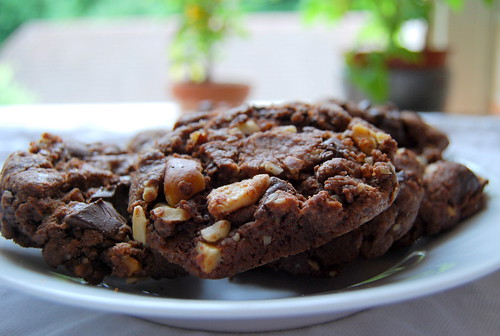
While I'm still not all that great at abstaining from sampling while baking, I've at least grown to become a little better at it. It takes a lot of self-discipline, and if you're willing to try it, I'd definitely recommend giving it a try. However, I began to realize that even though I was somewhat keeping my self from eating too much unhealthy food, I was still supplying others with loads of butter-heavy, empty calorie baked goods. I decided to start experimenting with some recipes, seeing if I could make healthier counter-versions that tasted just as great. And with that, I've decided to share with you one of my favorite suped-up cookie recipes. This recipe replaces some of the nutrient lacking white flour with fibrous whole-wheat flour, and also uses heart-healthy oil in replace of some of the butter called for in most cookie recipes. While I can't say it's necessarily a "healthy" snack, it is definitely superior to a lot of baked good you could be eating/making. This healthier treat maintains a rich, chocolately goodness that will leave you wanting to eat cookie after cookie (so maybe this is the time to test your self discipline too haha), without feeling quit so guilty.


TRIPLE CHOCOLATE COOKIES

-1/2 cup brown sugar
-1/4 cup granulated sugar
-1/4 safflower oil
-1/4 cup butter
-1 egg
-1 teaspoon vanilla extract
-1/2 cup whole-wheat pastry flour
-1/2 cup all-purpose flower
-1/4 cup unsweetened cocoa powder
-1/4 teaspoon salt
-1/3 cup dark chocolate chips/or chopped chunks of choc.
-1/3 cup milk or semi-sweet chocolate chips (choice of sweetness/choc. preference)
-2/3 cup chopped pecans
-1 teaspoon espresso powder, optional

Preheat oven to 350 degrees F. Combine the sugars and butter together until well mixed. Add the egg and oil, beating until creamy. Stir in vanilla. In a separate bowl, mix the flours, cocoa powder, salt, and espresso powder. Slowly add the dry ingredients to the wet ingredients, mixing until just combined. Add the chocolate and pecans, mixing until thoroughly distributed. Place heaping tablespoon-sized balls of batter onto an ungreased cookie sheet and bake for 10-12 minutes. Transfer cookies to a rack to cool.

Take the cookies out slightly under done, and they're best when at least slightly cooled. They also taste best within the first 2 days, so eat up and enjoy!

Friday, May 22, 2009

Final Breakfast of the Series

For your last breakfast idea, try cooking up an egg and pair it alongside some whole wheat toast, or even better, some oatmeal. Make it fried, scrambled, hard-boiled, or however you like it.

Eggs are a substantial way to start your morning off with some muscle-building protein. One egg contains a mere 70 calories, but provides approximately 6 grams of protein, and all of the essential amino acids. Eggs are also a good source of choline, a nutrient that helps brain function, and helps to regulate the nervous and cardiovascular systems. A recent study has shown that more than 90% of Americans are deficient of choline. Just one egg provides about 1/4 of your daily needs of choline.

Eggs are also a sufficient source of vitamin D, selenium, iodine, and B vitamins. Additional studies have proven that eggs protect eyesight and help prevent cataracts.

However, eggs should be eaten in moderation because they can raise cholesterol levels if excessively consumed. The yolk contains all of the cholesterol in eggs, but don't skip out on eating the yolk because it also provides many of the beneficial nutrients. I recommend limiting consumption of eggs to two days a week, however many experts consider eating one egg a day to be alright. If you already have high cholesterol, I would stay away from consuming eggs daily. When making eggs, I usually only cook one and add other fibrous foods like fruit and whole grains to fill up on. I would recommend this approach, unless you plan on making an omelet or scrambled eggs which generally require more than one egg.

Pair this breakfast with fruit. Like I mentioned previously, mango is my favorite fruit. If you have yet to taste a mango, be sure to give it a try. However, after purchasing it from the store, you many need to wait a few days for it to ripen up. It's well worth the wait though!

This concludes the healthful breakfast series. Remember, it is important to eat a healthy breakfast each morning to refuel your body and jump-start your day. Look to include whole grains, protein, and fruits/vegetables with each breakfast. I have given you 7 breakfast ideas, so if you fall into a slump and need a little help thinking of a creative way to make your morning meal, you will now have an idea for each day of the week. With a different breakfast for each day of the week, you're sure to never get bored, and will start making time and looking forward to eating breakfast each morning!

Thursday, May 21, 2009

Word on the Street, Ms. Blueberry is Who Oatmeal Wants to Meet


As soon as you let blueberries into your oatmeal pot for some mixing and mingling, you're sure to never go back (and they won't want to either). This combination tastes as good, if not better, than blueberry pancakes; And who doesn't love blueberry pancakes?

Blueberries are one of the most beneficial fruits of which you could add to your diet. They rate among the highest in antioxidant levels. A study done by Tufts University rated blueberries to be the highest in their capacity to destroy free radicals. They are relatively low-Cal, but high in vitamins. And when obtained in season, their sweet taste is one that very few foods can beat.

Like I've mentioned before, oatmeal is also a super healthy way to start your day. Oats a great source of insoluble and soluble fiber (a prime component of food that makes you feel full). Because of its insoluble fiber, oatmeal is said to lower LDL cholesterol (the bad kind). Oatmeal also helps to stabilize blood sugar, and has been shown to help reduce heart disease. Similarly to blueberries, oats contain beneficial antioxidants, such as selenium which is associated with reducing the risk of cancer.

The list of health benefits that both oatmeal and blueberries provide could go on and on. Put these two powerhouses together, and there's no way they couldn't do anything but boost your body's vitality.

To make blueberry oatmeal (2-3 servings):
-1 cup of old-fashioned oats
-2/3 to 1 cup of blueberries, washed
-Maple Syrup
-1 tsp. Sesame Tahini (optional)

Place one cup of oats with 2 cups of water in a pan. Bring the water to a boil, then place the lid on the pan. Turn the heat to low, and simmer for 10-15 minutes (personal discretion as to how done you prefer your oatmeal). Add the blueberries and cook until just a few start to burst and melt into the oatmeal (about 2-5 minutes). Place oatmeal into a bowl and stir in the sesame tahini if desired (this will add creaminess to the oatmeal). Drizzle maple syrup on top. Voila!

This breakfast tastes best when blueberries are in season. The oatmeal will be sweeter and will require less sugary maple syrup needed on top. Lucky for me, summer is on it's way, bringing its ripening powers with it. Bluberries should arrive around the end of June/ beginning of July, roughly two months away! You may want to add a few walnuts/almonds/etc. to round out this meal and add some extra protein to your breakfast.

Wednesday, May 20, 2009

A Quick Fix and My Food Combo. of All-Time

If you're on the run and need a quick way to fuel your morning, cereal just may be one of your best options. Simply pour some cereal and splash it with some milk (or I prefer soymilk). However, be careful what you choose because cereal can be loaded with sugar and empty calories. This morning I had a bowl of Heritage Flakes. This cereal is packed with organic ingredients and contains 6 grams of fiber (22% of your daily needs) and 4 grams of protein, with a mere 4 grams of sugar. One serving accounts for just 110 Calories.

Some other healthful cereals I enjoy (In general order of healthiness):
-Kashi GoLean (11 grams of protein, 8 grams of fiber! Add in some bananas, because although the cereal is not bad, it could use a little boost)
-Shredded Wheat (packed with fiber, also pairs well with slice banana)
-Total Whole Grain (Low calorie, fortified with vitamins)
-Cinammon Life (High in sugar, but made with whole grains, and provides 7 grams of protein. Eat more in moderation)

Those are just a few of the cereals I rotate around for breakfast. If you're trying to adjust from a more sugary cereal to one of the above options, try mixing a quarter of your favorite sweet cereal with 3/4 of one of the more nutritious cereals. Before you know it, you will gradually get used to the taste of the more simple cereals, and prefer them over a sickeningly sweet breakfast.

Pair your bowl of cereal with my favorite: BANANA WITH PEANUT BUTTER
I am constantly eating bananas with PB, whether it's for breakfast, a pre-run or post-run snack, or a late night indulgence. I absolutely love this combination. Quite frankly it could be one of my favorites, if not favorite thing to eat. I seem to never get sick of the combination. It's perfect for a morning start, as it combines fiborous, potassium-filled banana with a little bit of healthy fat and protein-loaded peanut butter. If you haven't tried it, it's a must do (unless you're allergic to peanuts that is, if so stay away and sorry for my ranting!).

A simple bowl of cereal paired with a banana and peanut butter will be sure to leave you full and satisfied all the way until lunch. So break open that banana and pop that box of cereal on your way out the door whenever you feel you're in a crunch for time.

Tuesday, May 19, 2009

Baby Will You Be My Yogurt and Fruit


There's no better combination than yogurt and fruit for breakfast. Mmm Mmm Mmm. Here's how I make my morning parfaits:

-Nonfat (or 2% if preferred) Greek Yogurt
-1/2 Banana, sliced
-1/4 cup Pineapple, chopped
-1 Orange, sliced
-Berries/mango/apples/any fruit on hand
-4-5 Walnuts, chopped
-1 Tablespoon of raisins (optional)
-Honey (optional)

Combine all the fruit in a bowl. Place a generous scoop of yogurt on top. Sprinkle the walnuts around and drizzle some honey if desired.

Greek yogurt has up to twice as much protein as regular. It also contains less sugar and is lower in lactose. It's texture is naturally more dense and creamy than that of the average yogurt, making it taste extra indulgent. It gets its creaminess from a straining process that removes the whey, or liquid, part of the yogurt. Try picking up some Fage Greek Yogurt instead of your regular Dannon/Yoplait/etc. yogurt at the store. Stonyfield also makes a Greek yogurt product, labled Oikos, which has gotten good reviews, however I have yet to try it.

Walnuts also add a substantiary amount of protein to this breakfast. They contain heart-healthy omega 3 fatty acids (actually contain more compared to most other nuts). Walnuts have been shown to lower levels of LDL cholesterol (the enemy kind). They are also rich in B vitamins and Vitamin E.

And as always, fruit contains a colorful array of vitamins and nutrients, as well as fiber. By placing these three ingredients together, you easily create a masterpiece of art just waiting to be eaten!